
Franklin County Probate Jurisdiction
Probate in Franklin County is not assigned to a separate surrogate, orphans, or county probate court. Kansas district courts have general original jurisdiction, and the Franklin County District Court handles estate administration, wills, guardianships, conservatorships, trusts, small-estate matters, and related probate filings. The local filing and copy counter is the Clerk of the District Court. That makes probate access part of the broader district court record system, even though probate files have their own case types, forms, and privacy concerns.
A Franklin County probate file may begin when a will is offered, an estate needs a personal representative, a guardian or conservator is requested, or a small-estate procedure is used. The file may include petitions, orders, letters testamentary or letters of administration, notices to creditors, inventories, appraisements, accountings, receipts, waivers, and final settlement documents. Guardianship and conservatorship records can include sensitive health, capacity, address, and financial information. Those facts may lead to redaction or limited access even when the docket exists.
The main local distinction is age. Franklin County publishes a separate old marriage and probate records process for files before February 15, 2001. Those older probate records are requested through the clerk in writing or by email, and the request should include the case number or book and page location when known. Current and newer probate case information may be searched through Kansas court systems or courthouse terminals, subject to public-access rules.
Franklin Probate Terms Defined
Probate records use short terms that carry real legal meaning. Reading those terms correctly helps separate a will filing from an estate administration, a guardian case, or a conservator case. The same Franklin County probate record may use more than one term if the estate has assets, heirs, creditors, and court-supervised duties.
- Testator
- The person who made a will.
- Executor
- The person named to carry out the will, if the court approves that role.
- Intestate
- A death without a valid will, so estate handling follows Kansas law and court orders.
- Guardianship
- A court case about personal care and decision-making for a minor or adult who needs legal protection.
- Conservatorship
- A court case about managing money or property for a protected person.
These terms may appear in CaseSearch, old probate indexes, orders, and Kansas Judicial Council probate forms. A term in a docket line is not the full file. The full probate record may still need a courthouse terminal search or a clerk copy request.
Search Franklin County Probate Records
Franklin County probate records can be searched through several channels. Kansas CaseSearch is the statewide public district court search system and may show public probate case information when the case is in the electronic system and is not restricted. The Franklin County court case information page also points users to courthouse public-access computers. Those terminals matter for older files, case types with online limits, and records that need clerk assistance.
- Start with the case number if it is known. For old probate records, include the case number or book and page location in the copy request.
- Search by party, decedent, estate, guardian, conservator, or business name in CaseSearch when the case may be in the statewide system.
- Use the Franklin County courthouse public-access computers when online results do not show the file or when the record may be older.
- For pre-February 15, 2001 probate records, contact the clerk in writing or by email and wait for the written copy estimate.
- For county administrative records rather than court case files, use the Franklin County open-records process through the county Freedom of Information Officer.
The Kansas Judicial Council publishes official probate forms, including probate and small-estate materials. Forms are not a record-search portal, but they are useful when a Franklin County probate case must be filed or when a small-estate affidavit is being considered.
The manifest source for K.S.A. 59-1507b shows the Kansas small-estates affidavit statute used in probate work.
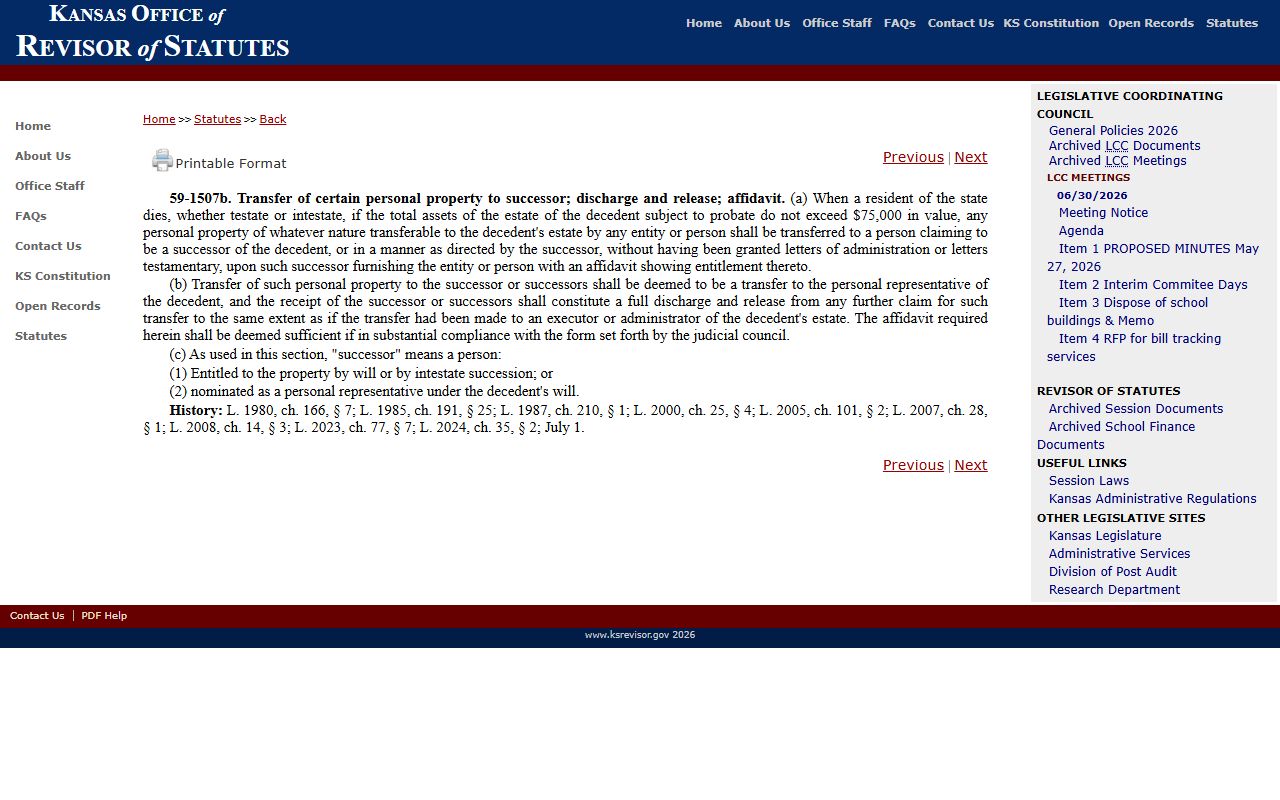
Small-estate affidavit records are tied to Kansas law, but the local filing and copy path still runs through the Franklin County District Court when a court file exists.
Franklin County Probate Court Contacts
The probate court contact for Franklin County is the Franklin County District Court and Clerk of the District Court. The court is part of the Fourth Judicial District, which also includes Anderson, Coffey, and Osage counties. Franklin County lists Theresa Morrow as Clerk of the District Court, with local district judges Douglas P. Witteman and Eric W. Godderz. For probate records, the clerk counter is the practical access point for filings, public terminals, copies, certified old probate documents, and questions about older file locations.
Franklin County District Court
301 S. Main
Ottawa, KS 66067
(785) 242-6000
Fax: (785) 242-5970
Monday-Friday 8 a.m. to noon and 1 p.m. to 4 p.m.
For county administrative records that are not probate case files, the Franklin County Clerk and Freedom of Information Officer is separate from the district court clerk. The county FOI office is at 315 S. Main, Room 106, Ottawa, and handles county KORA requests, not routine district court probate copies.
The manifest source for PACER's Kansas District Court lookup shows why federal court searches should be kept separate from Franklin County probate court records.
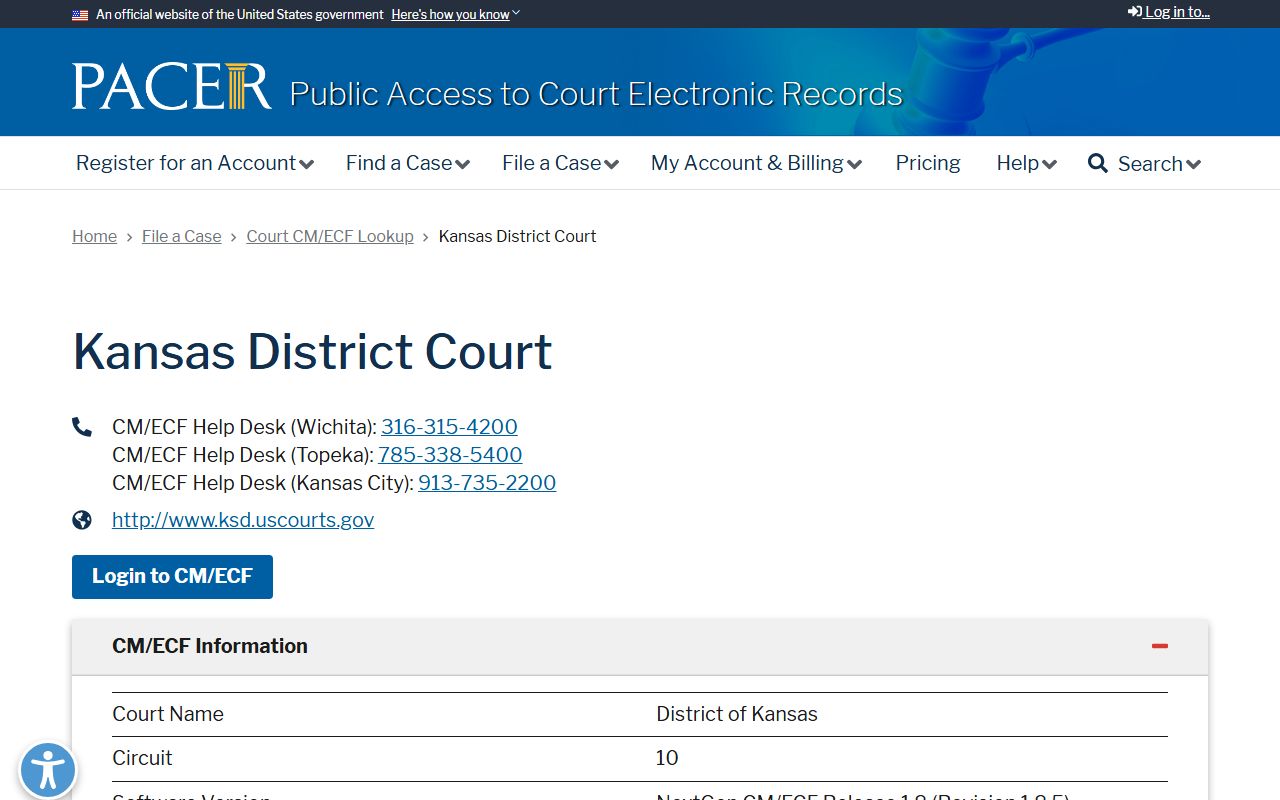
Probate estates filed in Franklin County District Court are Kansas state court files; federal district and bankruptcy cases use PACER or federal CM/ECF instead.
Franklin Probate Copy Fees
Franklin County official sources did not provide a complete current probate filing-fee schedule for new probate cases. The verified local fee data is for old marriage and probate record copies before February 15, 2001. The clerk prepares a written estimate after receiving the request. The requester then mails the estimated cost with a self-addressed stamped envelope so copies can be returned.
| Item | Amount |
|---|---|
| Old probate photocopies | $0.25 per page |
| Certification for old probate copies | $1.00 per document certified |
| Clerk research or copying time | $12.00 per hour |
| New probate filing fees | Confirm current docket fee with the clerk |
Do not treat the old-record copy schedule as the filing cost for a new estate, guardianship, or conservatorship. Filing costs can change, and probate filings may involve document, notice, service, or certification costs not shown in the old-record copy instructions.
The manifest source for the U.S. Bankruptcy Court for the District of Kansas is relevant when a Franklin County estate or heir has a separate federal bankruptcy matter.
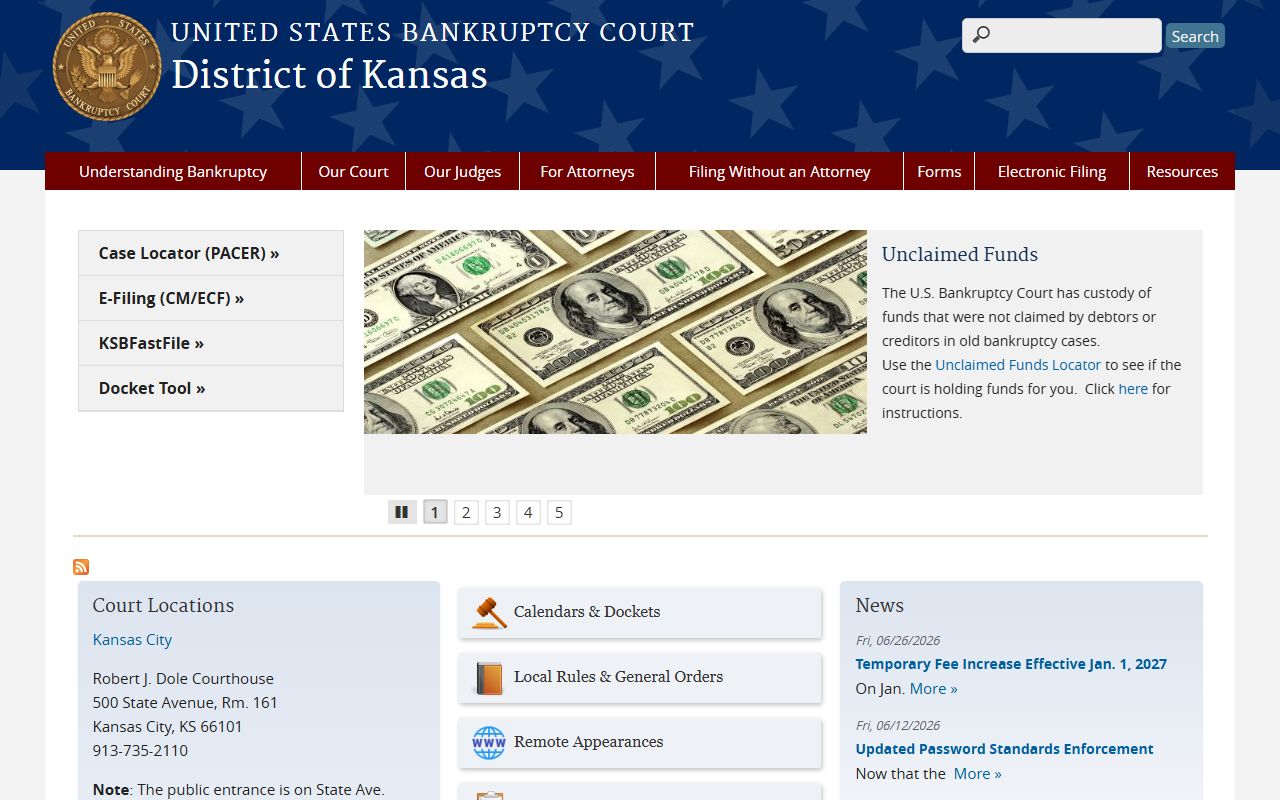
Bankruptcy files are federal records, so they are not copied through the Franklin County probate clerk process even when the person lived in Franklin County.
What Franklin Probate Records Show
Franklin County probate records may show the decedent or protected person, petitioner, heirs, creditors, attorneys, hearing dates, court orders, and the status of the estate or guardianship. A will case may include the will, petition to admit will, proof of death, appointment orders, letters, inventory, accounting, and final settlement. An intestate estate may include a petition for administration, heir information, creditor notices, and orders distributing property.
| Search Field | How It Helps | Notes |
|---|---|---|
| Case number | Fastest way to identify the file | Use it for current searches and old-copy requests when known. |
| Party or decedent name | Finds estate, petitioner, guardian, or conservator references | Online options depend on public access and portal role. |
| Book or page location | Helps retrieve older archived documents | Franklin County asks for this when available for old records. |
| Date range | Narrows older probate research | Useful when no case number is known. |
Some probate records also connect to marriage, divorce, real estate, or civil files. For example, an estate may require a certified death or marriage record from a state vital-record office, while a guardianship may refer to a separate family case. Certified vital records are not the same as district court probate copies.
The manifest source for PACER Case Locator shows the national federal case search channel, which is separate from Franklin County probate record lookup.
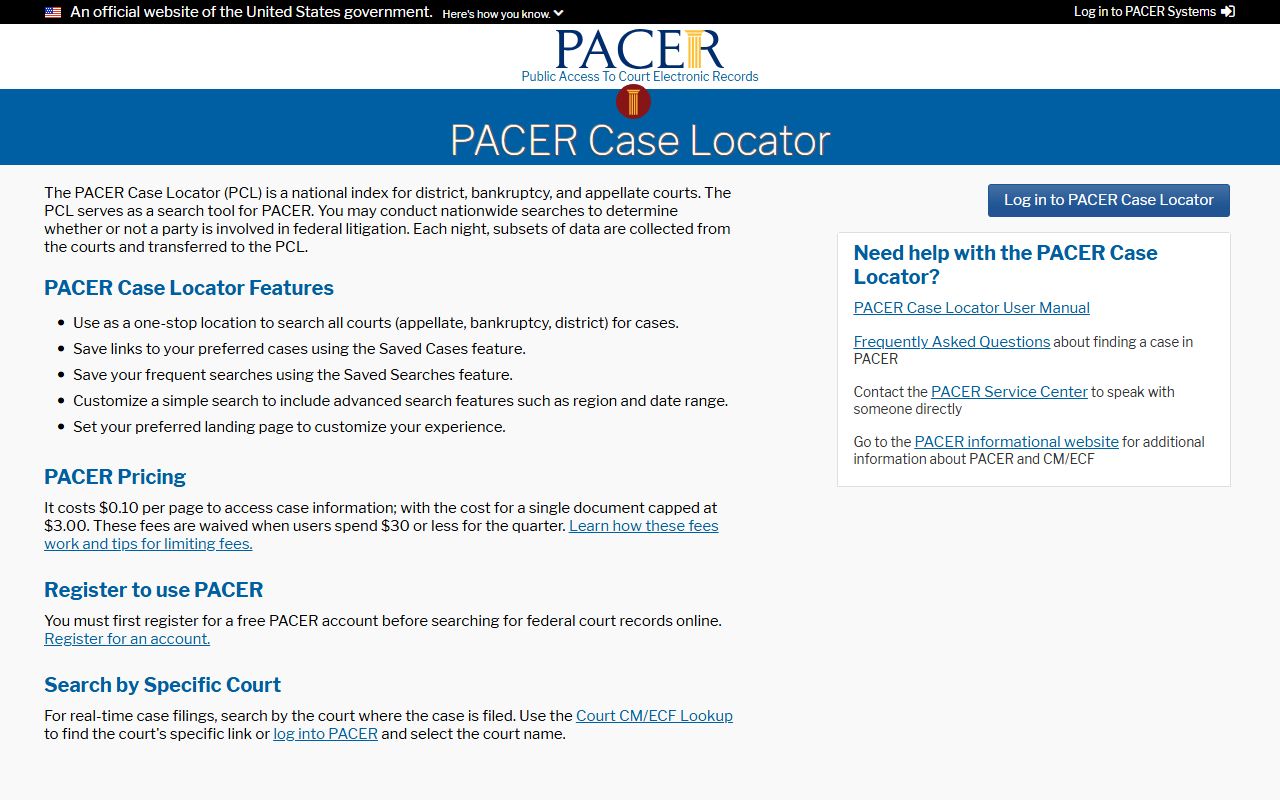
Use PACER for federal cases only; Franklin County probate record requests should stay with Kansas CaseSearch, courthouse terminals, or the district clerk.
Restricted Franklin Probate Records
Probate records are not all open in the same way. Guardianship and conservatorship files can contain medical, financial, minor-child, and personal identifying information. Care and treatment matters are also sensitive. Court rules, statutes, and judge-issued sealing orders can limit what a public user sees online or at a terminal. A docket may exist while certain documents remain unavailable to the general public.
Kansas public access rules and the Kansas Open Records Act should not be read as a promise that every probate document is public. Kansas Supreme Court Rule 106 governs court records, while K.S.A. 45-218 covers inspection requests for public records more broadly. The custodian can require a clearer request, charge allowed fees, or withhold closed material.
The manifest source for District of Kansas CM/ECF is another reminder that court record systems differ by court level.
When a Franklin County probate search crosses into federal litigation, the record custodian changes and the state district clerk is no longer the access point.
Note: Ask the clerk how a record is classified before ordering copies, because restricted probate files may require party status or a court order.