
Franklin County Arrest Records and Court Charges
Franklin County arrest records begin with the arrest or booking event. That side of the record may identify the arresting agency, booking date, custody status, bond information, or jail contact details if the information is available through Adult Detention or a public-record request. The official Franklin County Kansas Detention Center page did not publish an online jail roster during research, so the reliable local channel for custody questions is Adult Detention at 785.229.1220, with the Sheriff’s Office at 785.229.1200 for broader law-enforcement contact.
Court charges after arrest are different. The prosecutor decides what allegations to file, amend, divert, dismiss, or pursue. In Franklin County, that prosecutor is the County Attorney, and the court filing creates the charge record inside the Franklin County District Court case. The full criminal case file and final disposition belong on the criminal court records page; the jail booking and custody-status path belongs on the inmate records page. This page focuses on the connection between the arrest and the charges filed afterward.
The Franklin County Sheriff’s Office page is the source for the local law-enforcement office shown below.
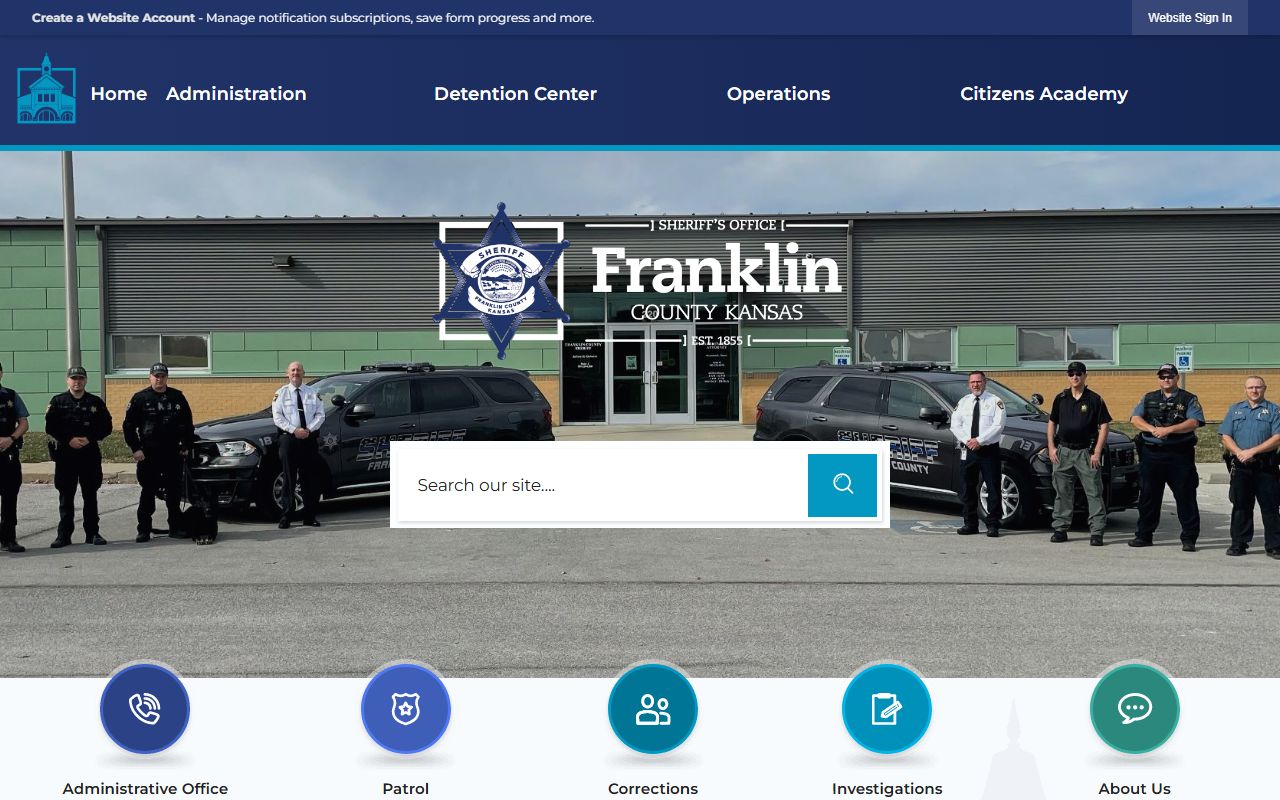
The sheriff source is relevant to arrest records, but it does not replace the court docket once a formal criminal charge is filed in District Court.
How to Find Franklin County Arrest Records and Charges
Start by identifying whether the need is booking/custody information or a court charge. For booking information, contact Franklin County Adult Detention at 220 S. Beech St., Suite A, Ottawa, or use the county KORA process for records not answered by phone. For court charges, search Kansas CaseSearch by defendant name, case number, or citation when available, then confirm the result is a Franklin County District Court case.
- For custody or booking status, call Adult Detention at 785.229.1220 because no official Franklin County Kansas online roster was located.
- For the filed charge, search CaseSearch by defendant name, case number, or citation.
- Open the district court case and read the charge list, prosecutor entry, bond or appearance status, and docket events.
- Check whether each charge is pending, amended, dismissed, diverted, or resolved by plea, verdict, or sentence.
- Use the Franklin Clerk of the District Court for certified copies or case records not visible online.
The Sheriff administration page names Sheriff Jeff Richards and Undersheriff Kiel Lasswell and describes sheriff duties.
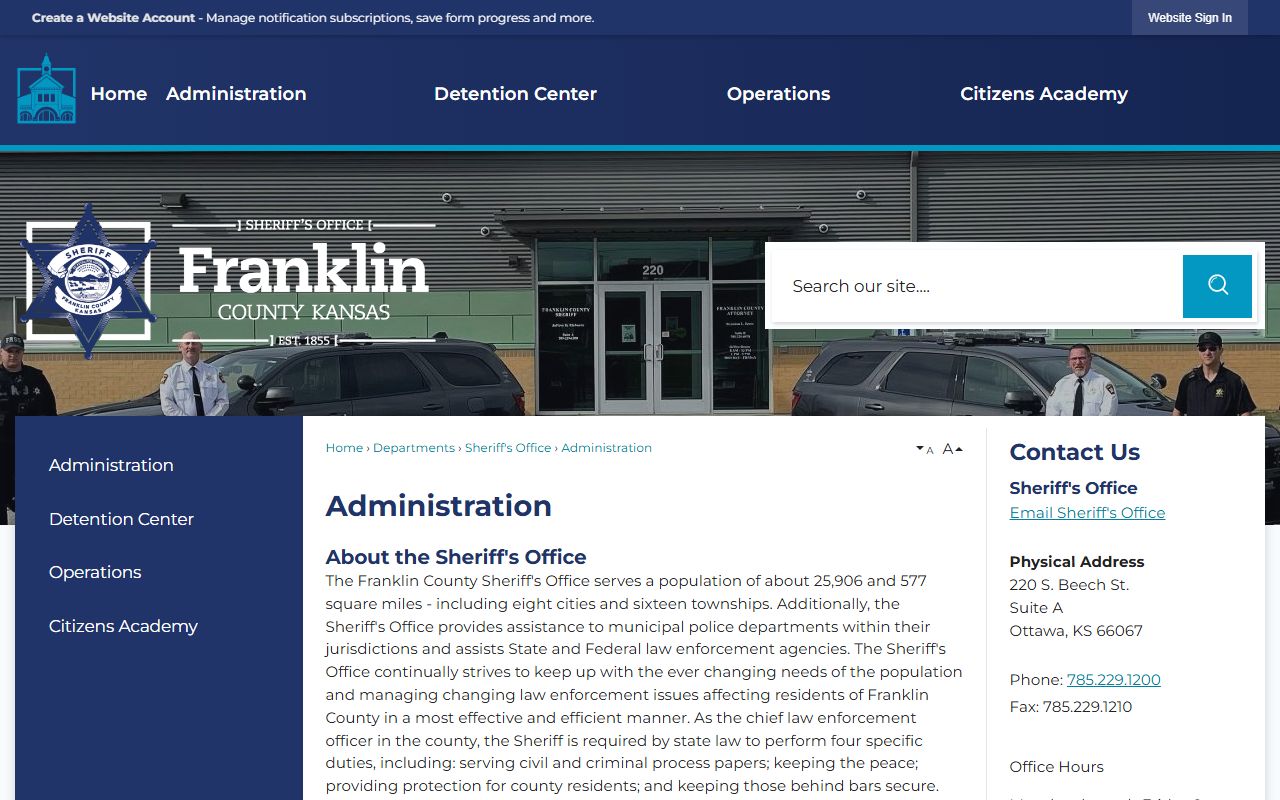
Those duties include civil and criminal process, keeping the peace, public safety, and secure custody, which explains why sheriff records and court charge records often connect but remain separate custodial sources.
The county’s non-emergent reporting contact page is another official law-enforcement routing source.
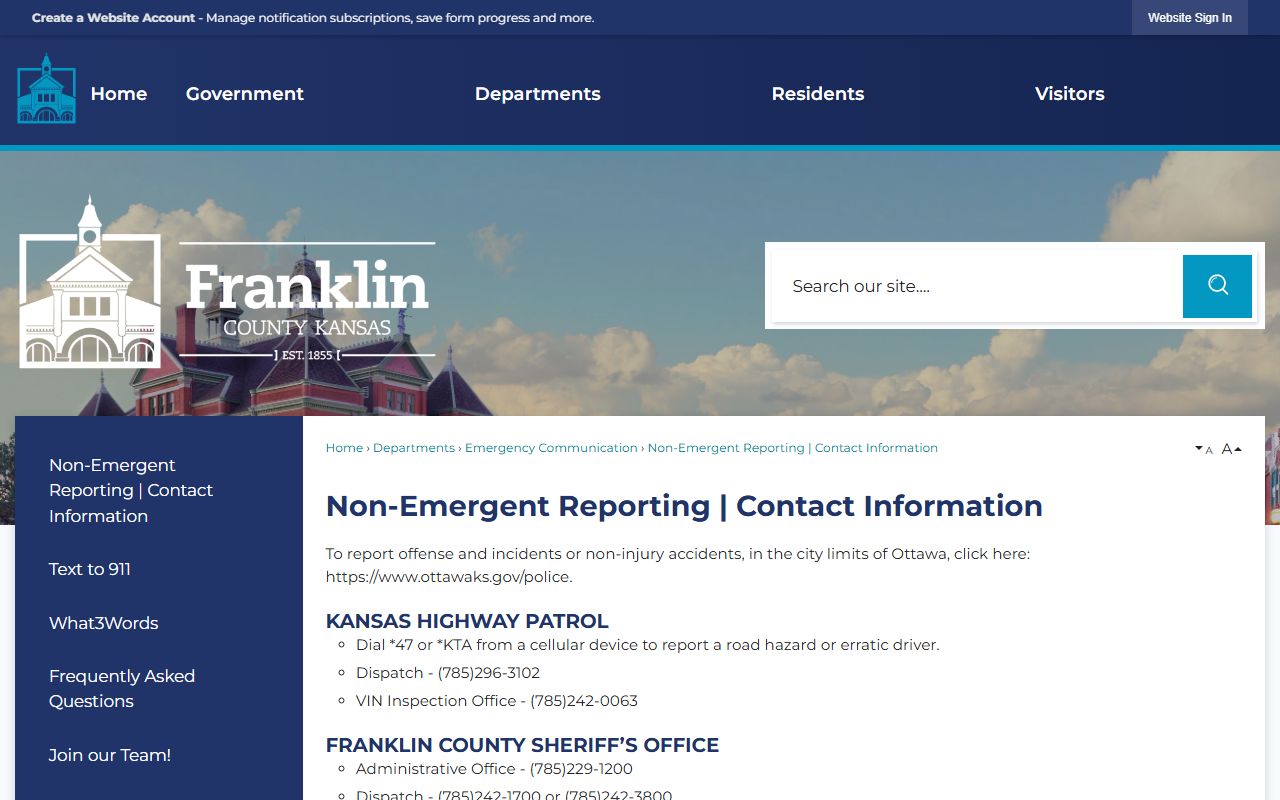
Non-emergency contact information helps identify agency routing, but charge status still comes from the court case after the prosecutor files.
How Charges Get Filed After an Arrest: Complaint, Information, and Indictment
After an arrest, a person may be booked or released before the court case is fully developed. The charge record begins when a charging document is filed with the court. In Franklin County criminal matters, the County Attorney’s role is central: the office prosecutes violations of Kansas criminal law, offers or rejects diversion, negotiates pleas, handles hearings, and can amend or dismiss charges. One arrest can produce one charge, several charges, no filed charge, or a later amended charge list.
| Complaint | Information | Indictment | |
|---|---|---|---|
| Filed By | Prosecutor or officer-based process | Prosecutor | Grand jury process |
| Common For | Initial criminal allegations or misdemeanor filings | Many felony prosecutions | Serious or grand-jury matters |
| Record Location | District court case file if filed | District court case file | District court case file if used |
Charge Status and What It Means
Charge status changes as the case moves from arrest to court events. A docket can show first appearance, arraignment, motion, diversion status, review, disposition, and sentencing. The prosecutor may amend a charge, reduce it, dismiss it, add another count, or resolve it through diversion or plea. A status label is not the same as a final judgment unless the docket or case document shows a disposition.
| Status | What It Means |
|---|---|
| Pending | The charge is filed but not finally resolved. |
| Amended / Reduced | The prosecutor or court record changed the original charge, level, or count. |
| Dismissed | The charge was ended by court action; check whether dismissal was with or without prejudice. |
| Diversion | The defendant may complete conditions that can lead to dismissal if successfully finished. |
| Conviction | A plea or verdict resulted in guilt and sentencing or judgment. |
Charges vs. Convictions
A charge is an accusation filed in court. A conviction is an outcome after a guilty plea, no contest plea accepted by the court, or trial verdict. Franklin County arrest records and court charges should therefore be read with the docket status and disposition. A person may be arrested and never charged, charged and later dismissed, placed on diversion, or convicted and sentenced.
| Charge | Conviction | |
|---|---|---|
| Stage | Allegation after arrest, citation, or investigation | Final or adjudicated outcome after plea or verdict |
| Proof | Based on probable cause and prosecutor filing decision | Requires court acceptance or proof beyond a reasonable doubt at trial |
| Record Use | Shows what was alleged and tracked in the case | Shows the adjudicated criminal outcome and sentence |
| Public Access | Often public unless sealed, juvenile, expunged, or restricted | Often public unless sealed, expunged, or otherwise restricted |
Sealed vs. Expunged Records
Sealed records are hidden from ordinary public view by court order or law. Expungement is a statutory process that limits public access to qualifying arrests, diversions, or convictions. Kansas uses specific expungement statutes, including K.S.A. 21-6614 for certain convictions, arrest records, and diversion agreements, and K.S.A. 22-2410 for eligible arrest-record expungement. Juvenile expungement and juvenile access are governed by separate juvenile-code provisions.
| Sealed | Expunged | |
|---|---|---|
| Visibility | Hidden from ordinary public access while the seal applies | Public access is limited under the expungement order and statute |
| Record Existence | The case or record still exists but is restricted | The record is treated under Kansas expungement law, with statutory exceptions |
| Access Path | Usually requires court order or authorized status | Requires the expungement order and statutory exception if access is allowed |
| Eligibility | Depends on law, case type, and court order | Depends on K.S.A. 21-6614, K.S.A. 22-2410, juvenile statutes, or other applicable law |
Charge Codes and Severity Levels
Charge records usually connect the alleged offense to a Kansas statute, municipal ordinance, or traffic citation. District court records may show felony, misdemeanor, traffic, juvenile, or other case categories depending on the filing. Ottawa Municipal Court handles local ordinance violations and traffic infractions, while Franklin County District Court handles state-law criminal cases and district traffic matters. A single arrest can produce several counts with separate statute numbers, severity levels, bond conditions, and dispositions.
The Franklin County docket examples showed CR and TR case numbers, and the County Attorney’s duties explain why prosecutors may amend or reduce charges as facts, negotiations, diversion eligibility, and plea discussions develop. The Franklin County Attorney page identifies Brandon L. Jones as County Attorney, while the Franklin County court-office page identifies Theresa Morrow as Clerk of the District Court. Sheriff Jeff Richards is identified on the Sheriff administration page. A charge code should be read together with the current status, not in isolation.
Statewide Charge and Criminal History Lookups
Kansas statewide criminal history checks are handled through the Kansas Bureau of Investigation, not through Franklin County District Court. KBI criminal history is useful for identity-based statewide background information, while Franklin County court charges are case-specific filings. The Kansas registered offender search and KBI missing-person search are also separate public-information channels; they are not substitutes for the local arrest record, jail record, or court charge file.
The KBI Franklin County missing-persons search is a law-enforcement public-information reference, not a court charge index.
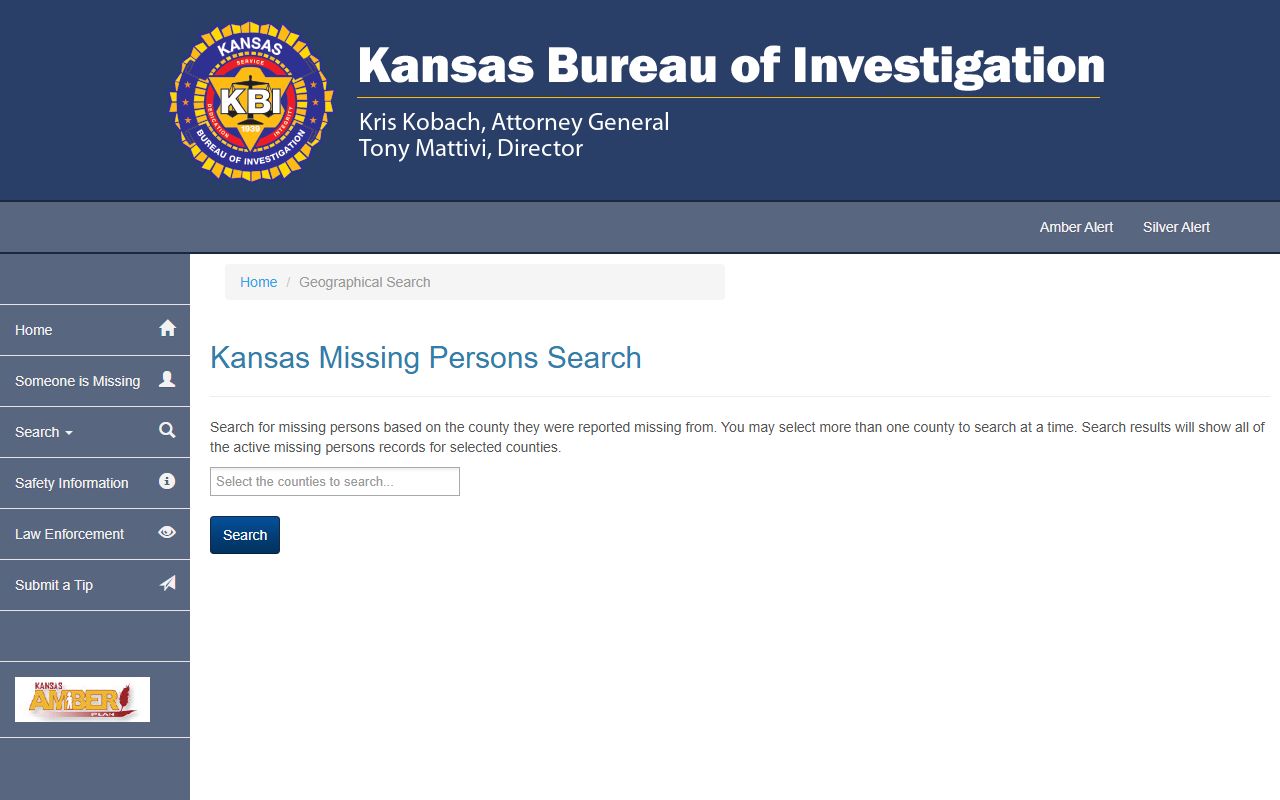
This distinction matters because public law-enforcement information can exist outside the Franklin County District Court case file.
Background Check Considerations
Casual searches of arrest records and charge records should not be used as consumer reports. A charge may be pending, dismissed, diverted, expunged, sealed, or misidentified if a name search returns a similar person. For employment, housing, credit, insurance, or other regulated decisions, use a compliant background-check process and verify official records with the originating agency or court.
Important: This website is not a consumer reporting agency and cannot be used for FCRA-regulated decisions.
Restricted Charge Records in Franklin County
Juvenile records are restricted under Kansas juvenile law. K.S.A. 38-2309 governs juvenile court record disclosure and preservation.
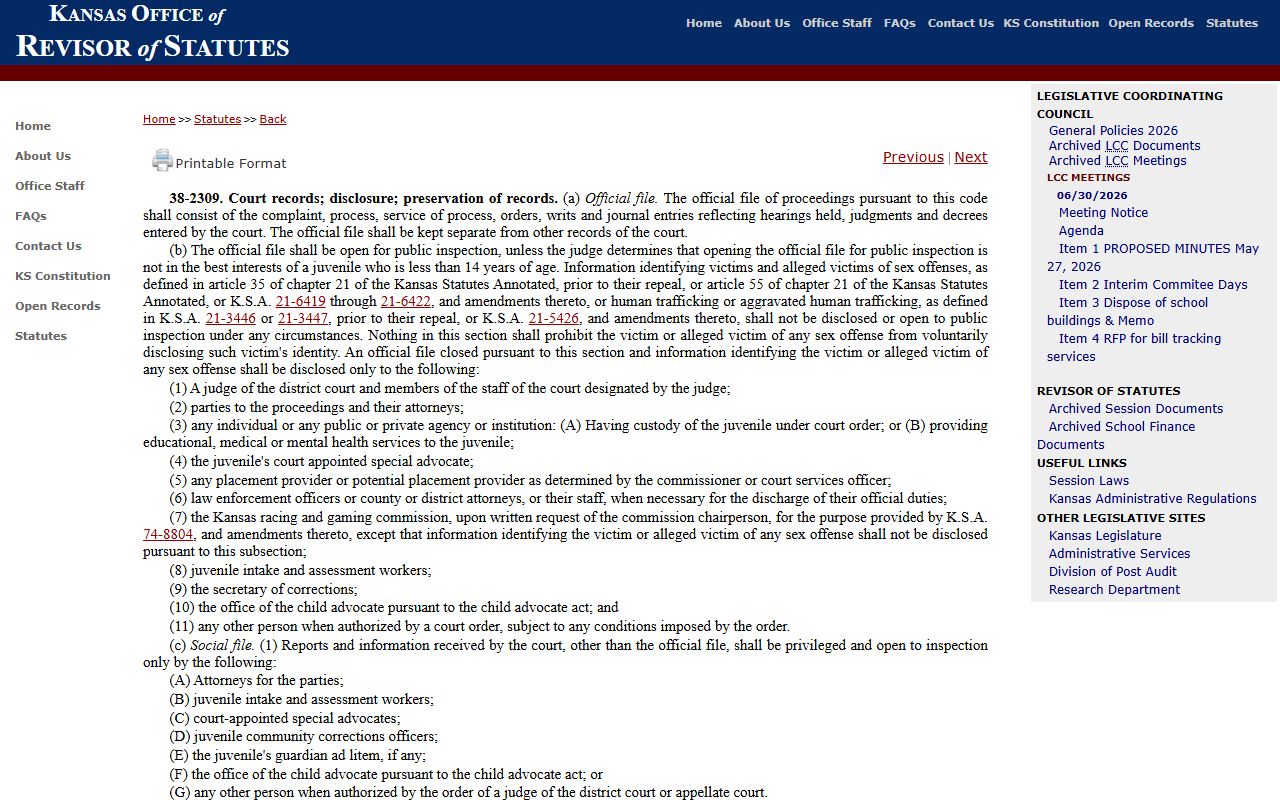
Juvenile charge information should not be described as ordinary public adult criminal access, even when an arrest or court event is known.
Juvenile expungement has separate statutory treatment. The K.S.A. 38-2312 juvenile expungement source is shown below.
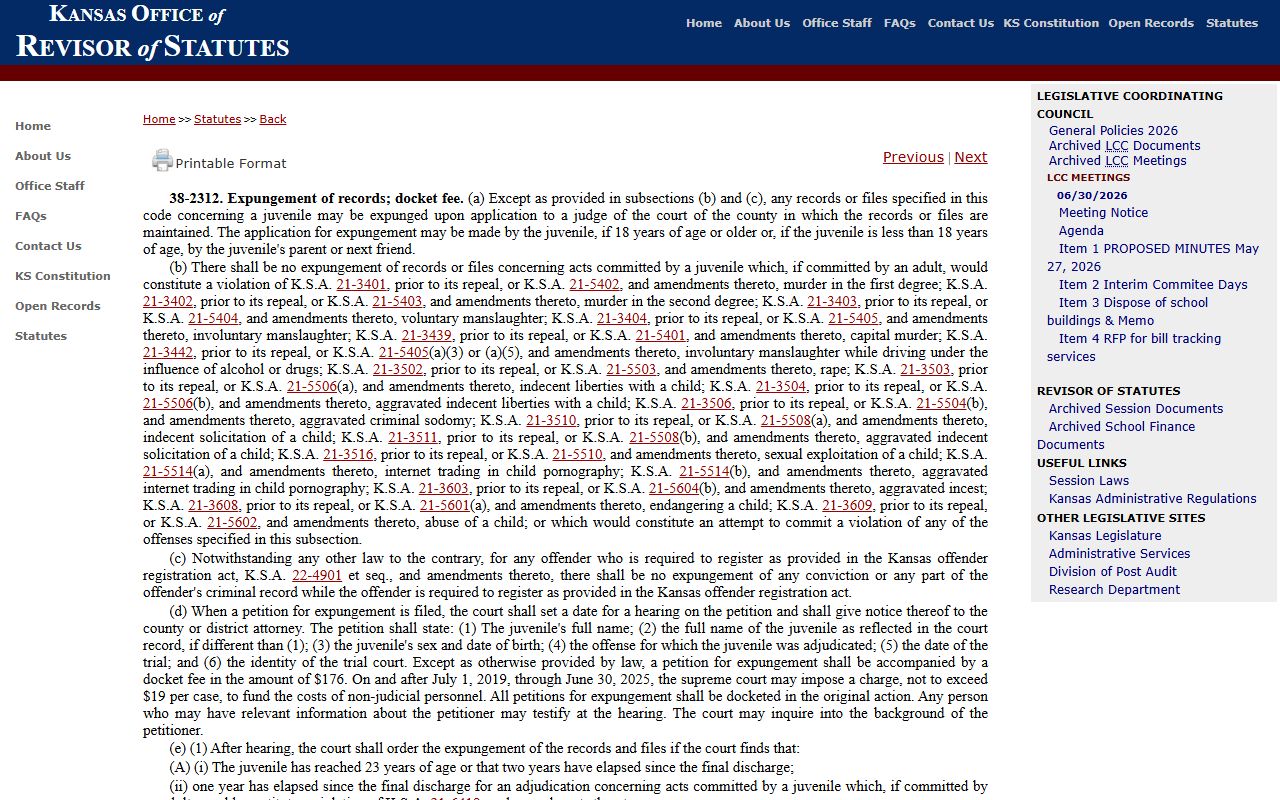
Other restricted charge records may involve sealed warrants, active investigations, victim safety, medical information, mental health proceedings, personal identifiers, expunged arrests, or sealed criminal cases. Use the Clerk of the District Court for court-file access questions and Franklin County KORA channels for non-court county records, subject to exemptions.